
Deodorizing a refrigerator yourself takes one session: empty it, toss anything spoiled, wash the shelves and walls with warm water and about 2 tablespoons of baking soda per quart, dry everything, then set an open box of baking soda on a middle shelf and replace it every 3 months. On a built-in Sub-Zero, skip the popular vinegar tip: Sub-Zero's care guidance rules out vinegar and alcohol-based cleaners inside the cabinet.
If a sour or musty note returns within a week or two, the smell is coming from a spot a sponge misses: the door gasket folds, the ice bin, an old water filter or a cabinet running too warm.
How do you deodorize a refrigerator step by step?
Step 1, prepare: turn the Sub-Zero off at the control panel and move food into coolers with ice packs, so nothing perishable sits above 40 degrees for more than 2 hours.
Step 2, purge: throw out anything expired, moldy or questionable, opening every container. Lift out the crisper drawers and check underneath, where a leaking bag of greens can leave a puddle.
Step 3, wash removable parts: clean shelves, door bins and drawers in warm water with mild dish soap, then rinse and dry them. Let cold glass shelves reach room temperature first, because hot water on chilled glass can crack it.
Step 4, wash the cabinet: wipe the walls, ceiling, floor, shelf supports and back corners with a soft cloth dipped in the baking soda solution, then wipe with clean water and towel dry.
Step 5, restart: switch the Sub-Zero back on, let the compartment reach its set point, and reload only food that passes the sniff test, in covered containers.
Should you use vinegar or bleach on a Sub-Zero?
Vinegar is the most repeated deodorizing tip online, and it is the one to leave in the pantry for a Sub-Zero refrigerator. Sub-Zero's use and care guidance calls for soap, water and baking soda on the interior and says never to use vinegar or alcohol-based cleaners there. For the Sub-Zero door gasket, the guidance is mild detergent and water on a soft cloth, a baking soda paste for stubborn stains, and no vinegar or rubbing alcohol.
Bleach has one narrow job on a Sub-Zero: mold or mildew in the door gasket. For that, Sub-Zero suggests 1 part bleach to 10 parts water, applied with a soft cloth while the unit is off. Rinse the gasket with clean water, dry it, keep the bleach mix off food shelves, and never combine bleach with ammonia.
What absorbs refrigerator odor best after cleaning?
Baking soda is the cheap, proven default. Pour it into a shallow dish or leave an open box on a central shelf where air circulates, and replace it every 3 months; a box buried behind leftovers does far less.
Activated charcoal generally clears a strong refrigerator smell faster and suits stubborn problems, such as after a power outage. Use the charcoal loose in a breathable sachet or shallow dish and refresh it as the package directs.
Coffee grounds or a cut lemon mask refrigerator odors more than they absorb them, and coffee scent can drift into butter. Scented sprays do not belong in a food compartment at all. Any absorber buys time but cannot fix a source, and a smelly freezer needs its own dish of baking soda.
Where do lingering smells hide in a built-in refrigerator?
Musty smell at the door edge: mildew is growing in the folds of the Sub-Zero door gasket. Open each fold and clean it with the 1:10 bleach mix. Call a technician if the gasket is torn, flattened or no longer grips a sheet of paper closed in the door.
Stale-tasting ice: ice cubes absorb refrigerator odors and age in the bin. Empty and wash the bin and change an overdue water filter. After a new filter, Sub-Zero says Classic (CL) and Designer (DET, DEC) models without a dispenser should discard the first two full bins of ice, dispenser models should run water for 2 minutes, and the UC-15I discards its first batch. Call a technician if fresh ice still tastes off.
Sour smell under the crisper drawers: produce liquid or a leaking package has pooled under the drawers or in the slides. Pull the Sub-Zero drawers fully, wash the floor and slides with the baking soda solution, and dry them. Water that keeps reappearing with nothing spilled points to a drain problem and a technician.
Musty or dusty smell near the top grille or kickplate: frost-free refrigerators send defrost water to a drain pan near the compressor, and dust on the condenser can smell warm. Reaching that drain pan on a built-in usually means sliding the unit out of its cabinet, a technician job.
When does a fridge smell mean repair instead of cleaning?
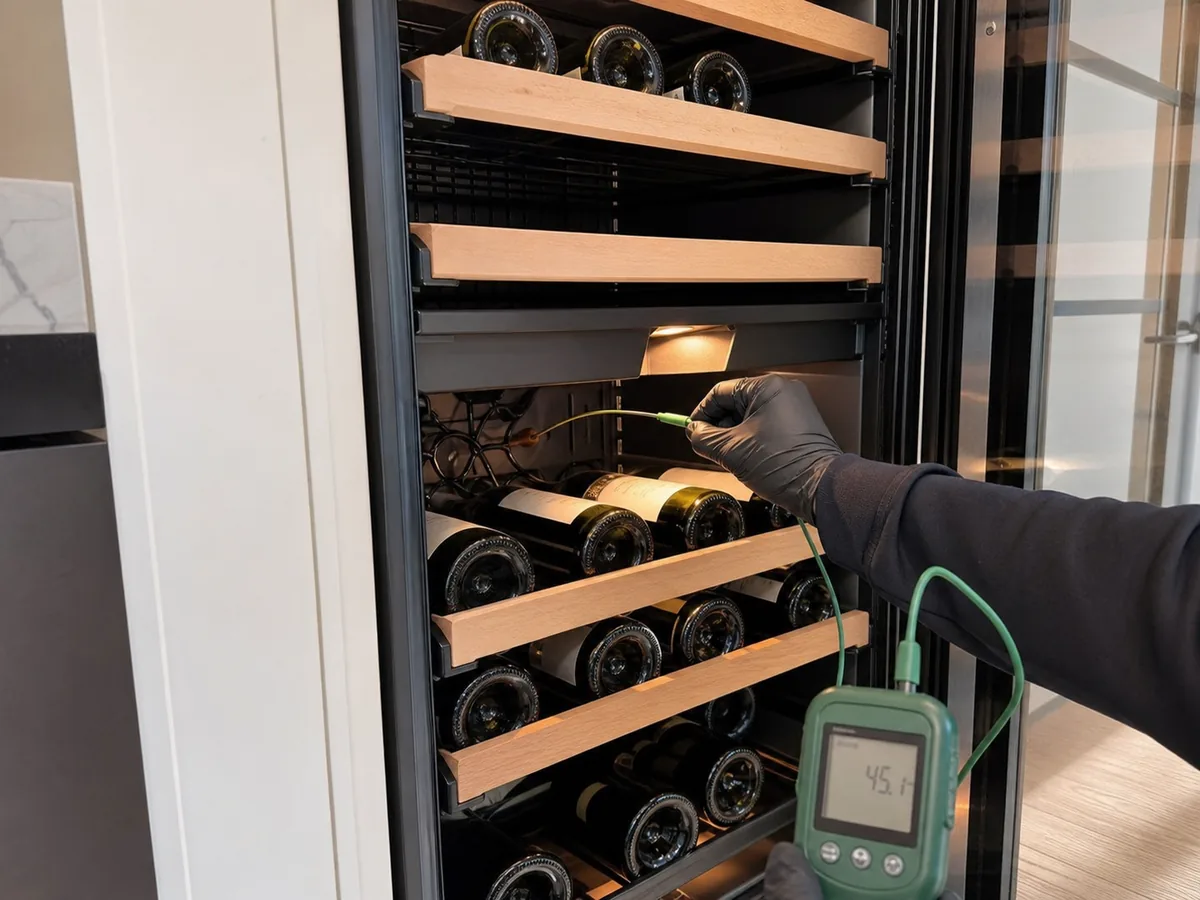
A refrigerator that keeps smelling sour after a full cleaning often runs too warm, because food spoils faster above 40 degrees. Leave an appliance thermometer in a glass of water on a middle shelf overnight and read it the next morning.
Sub-Zero draws a clear line: if the refrigerator reads above 48 degrees while set at 38, a condenser cleaning is unlikely to bring it back, and service should be called. Below that point, rule out a dusty condenser. Sub-Zero recommends cleaning the condenser every six to twelve months, more often with pets, and says a unit less than 6 months old does not need it.
On a Classic (CL) model, the Sub-Zero condenser sits behind the flip-up grille; on a Designer (DET, DEC) model it is behind the kickplate, held by two screws. Turn power off at the control panel, wear gloves, and vacuum with a soft brush in the direction of the fins so the aluminum does not bend. Chemical condenser cleaners are unnecessary and not recommended.
A hot electrical or burning-plastic smell is different: switch the refrigerator off at the breaker and call a technician.
Keeping a built-in fresh between deep cleans
A weekly two-minute sweep keeps a Sub-Zero fresh: toss leftovers older than 3 to 4 days, wipe drips right away, and keep onions, fish and soft cheeses sealed.
In Hillsborough, codified zoning sets half-acre minimum lots and allows no commercial businesses, so every grocery run leaves town and many kitchens stock up. A full Sub-Zero can hide an old container behind newer ones for weeks, so rotate older food forward at each restock.
Before an extended trip with a Classic (CL) or Designer (DET, DEC) unit, Sub-Zero says to turn power off at the control panel, empty the refrigerator, block the doors slightly open so the interior stays dry, and replace the water filter before start-up. A closed, powered-off Sub-Zero cabinet grows mildew quickly.